
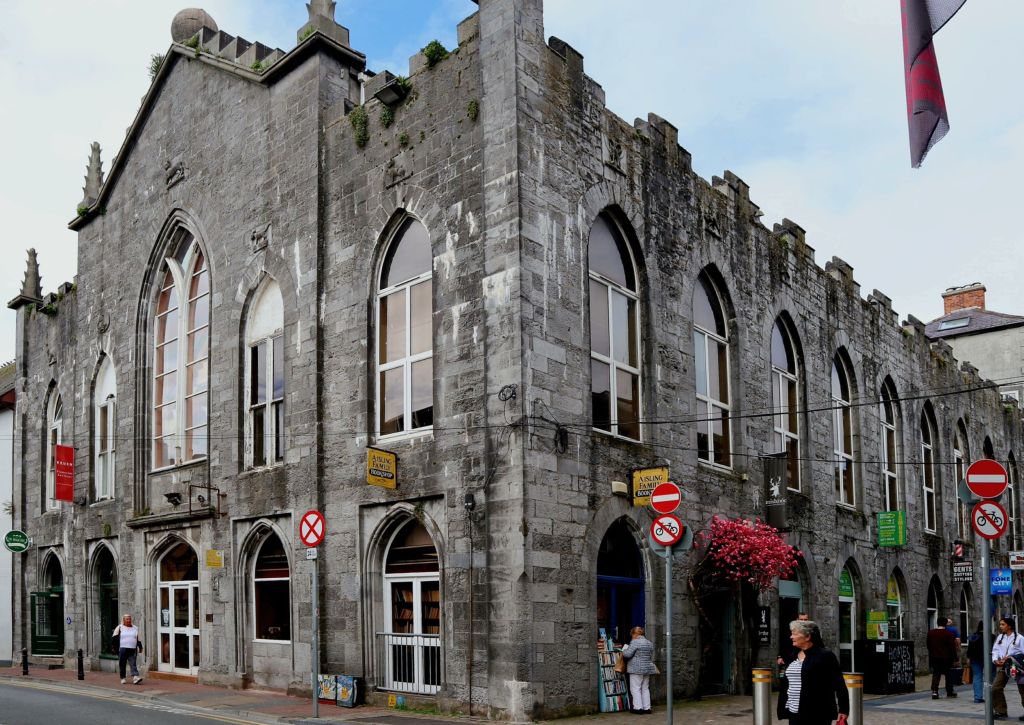
Galway’s Pro-Cathedral is at the corner of Abbeygate Street and Middle Street. It was highly significant as a religious building in its day. It was commissioned in July 1816. There are many mysterious stone carvings, called ‘1816 Stones,’ around the city marking this date. The building was opened in 1829 towards the end of the Penal Law era.
In those bitter times, Catholics were prevented and penalized for practicing their religion. This resulted in Catholic Mass locations being kept secret and priests often wearing disguise.The Penal Laws, however, were not as rigidly enforced in Galway City as elsewhere. The Protestant authorities in Galway mostly turned a blind eye to the celebration of Mass and to priests activities.
The laying of the foundation stone demonstrated friendly relations. These relations existed between the Protestant and Catholic clergy. It took another thirteen years for the Penal Laws to be fully abolished. This made the ‘official opening’ of a Catholic church by the local Protestant ascendancy very unusual for that time! The unique event was reported in print. The report detailed the presence of leading Protestants. These included clergy, gentry, and the head of the Protestant corporation, Mayor Hyacinth Daly. This was to the delight of a crowd of approximately 10,000 who attended. The general opinion was 1816 Stones mentioned above were essentially carvings on buildings and walls commemorating this event. These carvings were usually accompanied by inscriptions such as the IHS or INRI lettering.
The building was completed and opened in 1929. At the time it was described by Galway historian, Hardiman as ‘a considerable ornament to the town, and be one of the most spacious and elegant Catholic chapels in the Kingdom’.
The Pro-Cathedral was de-consecrated in 1965 as the new Galway Cathedral was opened .
#church Galway city
 Western Tours and Tales