
The bustling city of Galway was chosen as the European Capital of Culture in 2020. It has historically had a close trading relationship with both Spain and Portugal. This is due to its location in Western Europe. Back then, Dublin’s ruling class referred to Galway as ‘more Spanish than Irish.’ This was because many Spaniards took up residence in the city.
Galway has its roots in medieval times. One of its main characteristics is that it was a Walled city. The DeBurgo settlers constructed most of the walls in the 12th and 13th centuries. These fortified walls were built to keep invading armies and unwelcome forces out. They also protected the merchant classes within. The 1651 Pictorial Map of Galway shows the fortified City walls. These walls consisted of fourteen towers and fourteen main streets. They also included many luxury homes owned by merchant families.
The new Settlers at the end of the 13th century in Galway became famously / infamously known as the Tribes of Galway. These fourteen Tribal families became commercially successful and prosperous. Foreign trade was the key to their success and Medieval Galway became an important international port. These settlers, who were of French, English or Welsh origin, became all-powerful. Irish became their first language and they were practicing Catholics. They set up Trade routes to France, Portugal and particularly Spain and the old Port area was an extremely busy part of the old city.
The famous explorer Christopher Columbus visited Galway in 1477 and is said to have worshipped at St. Nicholas’ Church before sailing on in his quest to find the New world.
A darker chapter in Galway’s connections with Spain happened in September 1588. This occurred after King Philip II’s Spanish Armada failed to invade England. The fleet comprised of 130 Ships and 22000 Sailors and Soldiers. Strong gales in the English Channel blew the fleet northwards off course in July of that year. Surviving ships began sailing for home via the North Atlantic. But by mid-September, a fierce storm off the West coast of Ireland forced some of the ships inwards towards the west coast. A total of 25 ships and about 5200 men were eventually lost off the coast. 300 Sailors survived, who were handed over to the English authorities. These sailors were taken into Galway’s Fort Hill Cemetery and brutally murdered on the orders of Sir William Fitzwilliam. The executed prisoners were all buried in a mass grave and to this day this act of cruelty remains a brutal episode in Galway’s history.
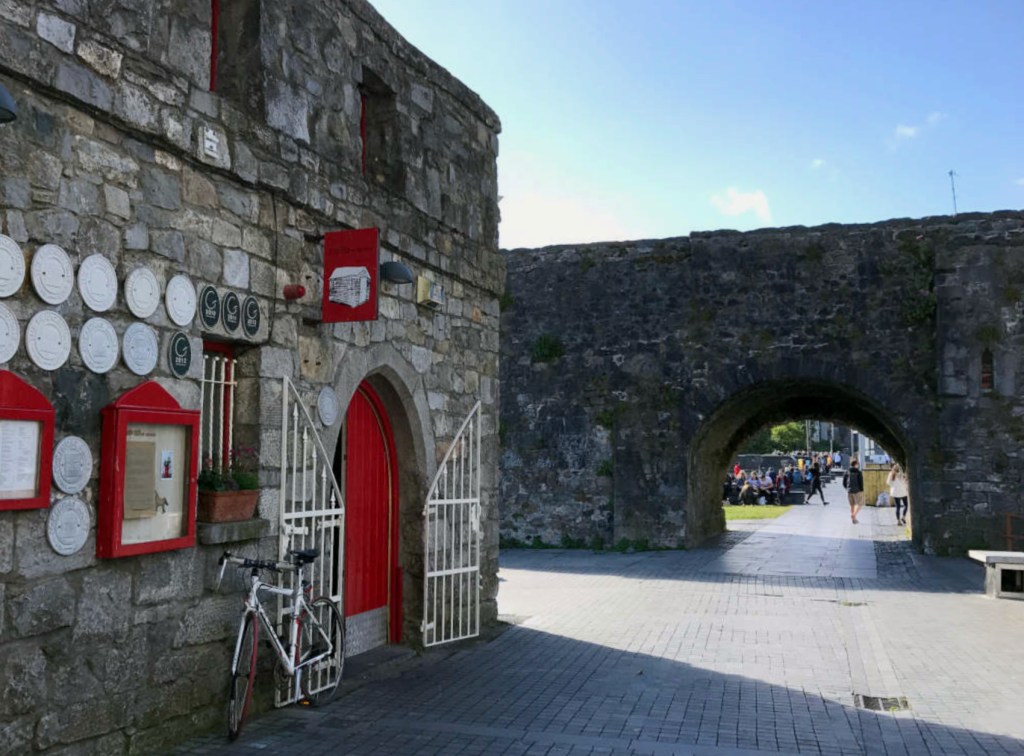
The Spanish Arch is one of Galway’s historical gems, dating back to pre-medieval times and was coined after the Spanish. It is one of the last remaining pieces of Galway’s historical City walls. The Arch, built in 1584 is an extension of the 12th century Norman-built wall is located on the left bank of the Corrib River as it reaches the sea, just at the edge of the city centre. It overlooks the old Claddagh fishing area. In medieval times, European ships and galleons would often dock alongside the Arch at the docks. They carried cargo of wine and spices along with their valuable goods. But in 1755, the famous Arch was extensively damaged by a tsunami off the coast of Lisbon and today only two arches remain.
By the beginning of the 16th Century, ‘the great town of Galway’ was known as a prosperous city. It had about 2000 people. So, at this time there was a large amount of trade done with Spain which resulted in a strong Spanish influence on Galway culture and fashion. Galway people were regarded as educated and sophisticated in manners and style! Santiago de Compostela is the capital of the Galician province. Back then, many Galway families made pilgrimages to the Shrine of St James in the Galician capital .
Today, Galway is regarded as a safe city. Hundreds of Spanish and Italian students visit Galway in the summer months to improve their English. These visitors are a great addition to the city and you encounter many of them along the Latin Quarter, near the Spanish Arch and in various Tapas bars in the city.
The Western Tours and Tales (WTT) City walking tours take in the old Town and Spanish Arch areas. They make an ideal place to meet up with mates, to hang out and take in the beauty of the old Claddagh area of the city. There are usually buskers playing under the arch. Meanwhile, revelers enjoy sunny days by the long walk or at the Middle Arch.
 Western Tours and Tales